API Development Best Practices in 2026

Most startup APIs don’t collapse on day one, They slowly run.
First it’s one breaking change. Then version confusion. Then new developers are afraid to touch core endpoints.
I’ve seen this happen in small SaaS teams scaling from 0 to 100k users, The API works — until it doesn’t, And by then, refactoring feels impossible.
This isn’t about trends. It’s about maintainability.
Why This Problem Actually Happens
It rarely starts as bad engineering.
It starts with pressure.
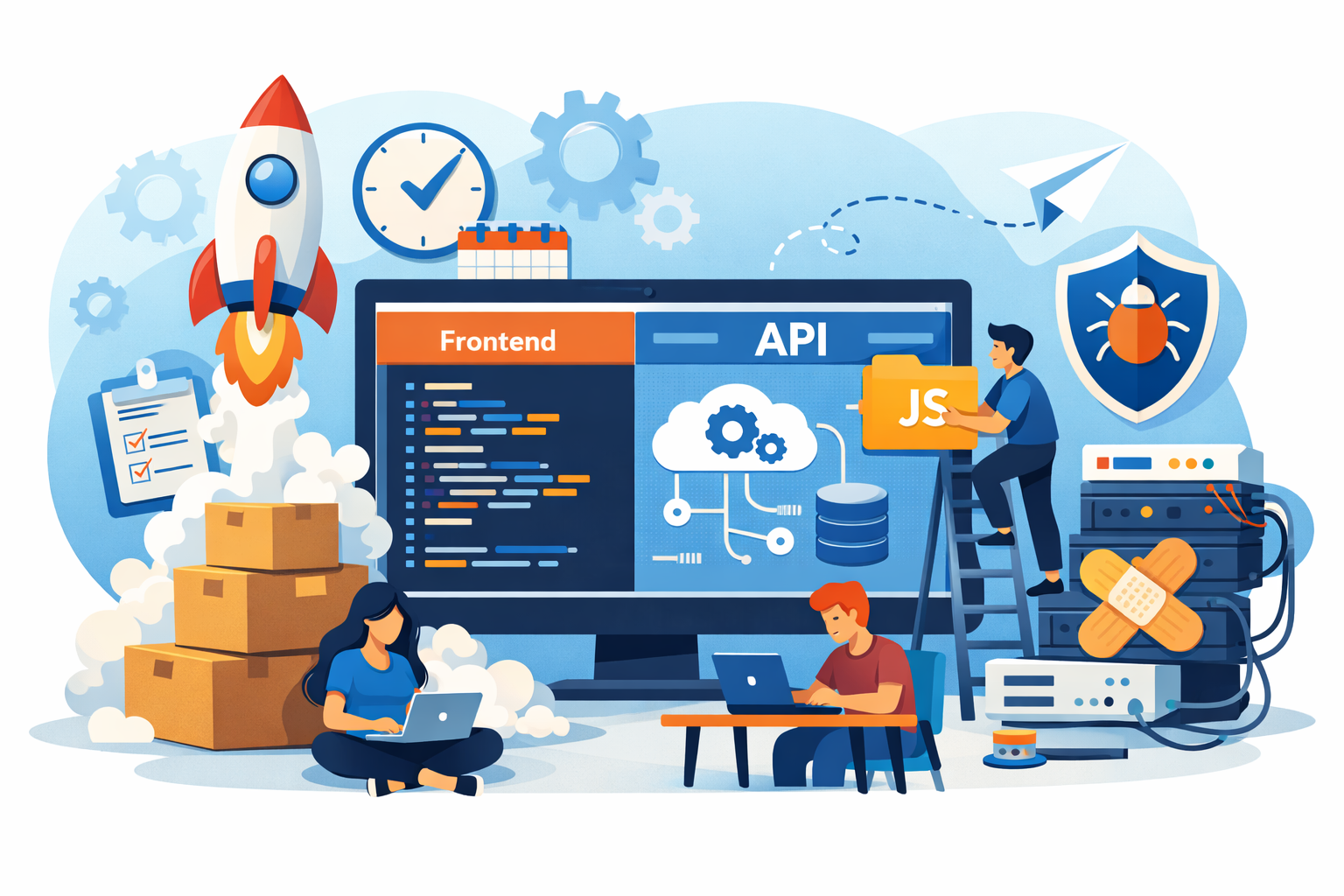
In early-stage startups, we optimize for shipping.
The API is “just for the frontend.”
So we:
- Skip strict contracts
- Return whatever shape works today
- Change response structures casually
- Add fields without thinking long-term
Then growth happens.
Mobile apps depend on it, Third-party integrations appear, Internal tools reuse the same endpoints, Suddenly your “internal API” is production-critical infrastructure.
Another big reason? Copying architecture from companies like Netflix or Amazon.
I’ve seen 4-person teams adopt microservices because a blog post said it’s “future-proof , What they actually built was distributed complexity without distributed scale.
The real cause isn’t technical ignorance.
It’s:
- Shipping-first culture
- No contract discipline
- Blurry boundaries between internal and public APIs
- Premature architectural decisions
APIs age badly when they aren’t designed to evolve.
Where Most Teams Get This Wrong
1. Premature Microservices
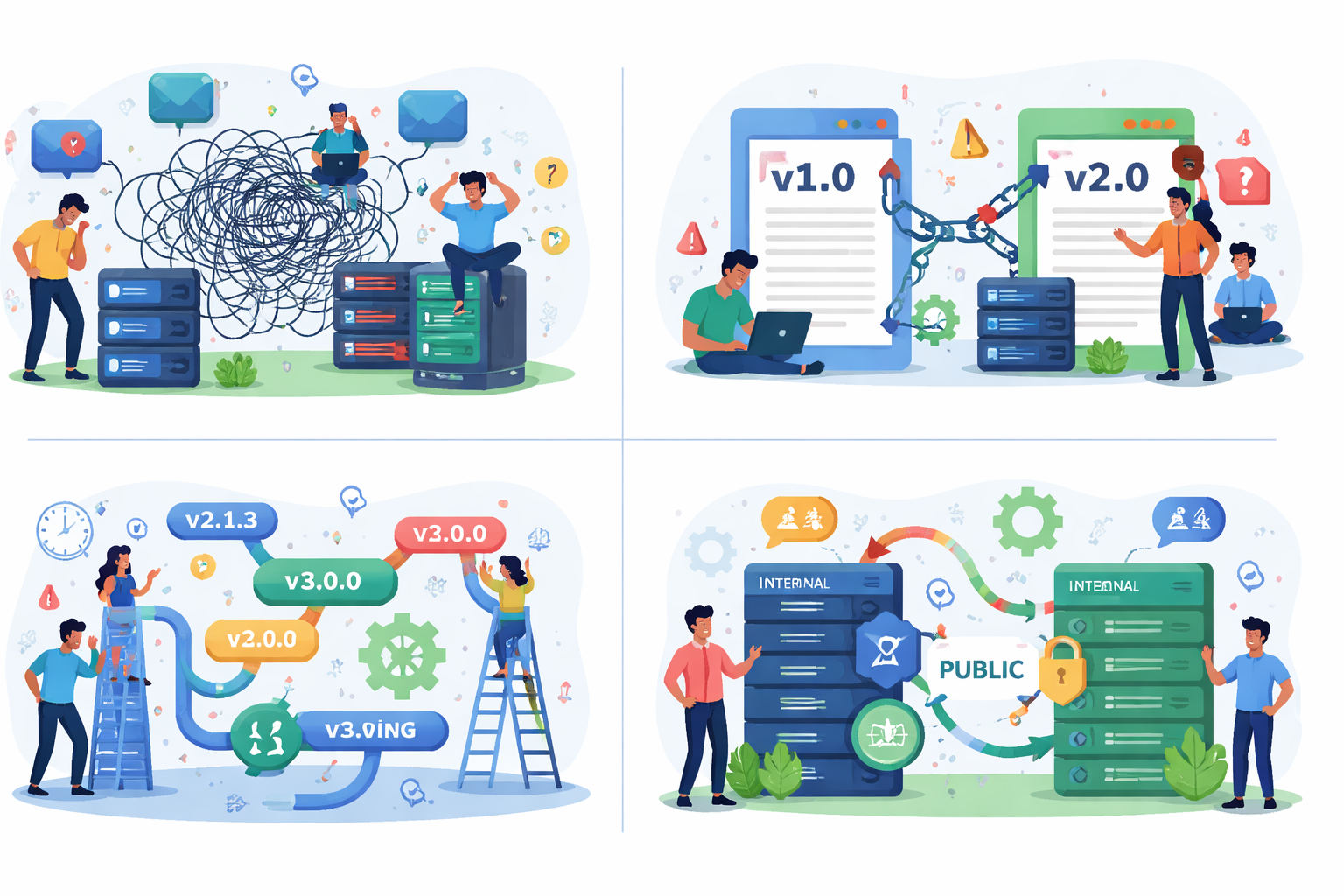
Premature microservices usually happen when small teams copy large-scale architectures before they actually need them. Instead of solving real scaling problems, they introduce deployment complexity, inter-service communication issues, and harder debugging.
For early-stage products, this often slows development down rather than improving scalability or maintainability.
I’ve seen teams split into 8 services with 6 developers.
Why?
“Scalability.”
What actually happened:
- Cross-service dependencies exploded
- Simple changes required 3 PRs
- Versioning became inconsistent
- Debugging required distributed tracing for basic issues
We once spent two days debugging a response mismatch caused by inconsistent schema validation between services.
Microservices don’t solve bad API contracts. They amplify them.
2. Ignoring Backward Compatibility
Ignoring backward compatibility usually starts with small, “harmless” changes to response structures or field names. Teams assume only their frontend depends on the API, so breaking changes feel low risk.
Over time, older app versions, integrations, and background jobs begin to fail silently. What seemed like a quick cleanup turns into long-term instability and emergency fixes.
In most startups, this happens because:
- “Only our front end uses it.”
- “We’ll update the client.”
- “No one else depends on this.”
Then you forget about:
- Old mobile app versions
- Cached responses
- Partner integrations
- Background jobs
Breaking changes are easy to introduce and painful to undo.
The common mistake: changing response structure instead of extending it.
3. Overcomplicated Versioning
Overcomplicated versioning happens when teams introduce multiple versioning strategies without a clear policy. Mixing URL versions, header versions, and per-endpoint variations quickly creates confusion.
Instead of improving stability, it makes the API harder to maintain and harder for clients to understand which version is safe to use.
I’ve seen:
- /v1/, /v2/, /v3/, /v1.1/
- Header-based versioning + URL versioning combined
- Per-endpoint versioning logic
It becomes chaotic.
In one project, half the routes used path versioning, and others relied on custom headers. New developers had no idea what was stable.
Versioning isn’t about numbering. It’s about stability guarantees.
4. Mixing Internal and Public Concerns
Mixing internal and public concerns happens when database models or internal logic are exposed directly through the API. This makes the API tightly coupled to implementation details that were never meant to be stable.
As the system evolves, even small internal changes become risky because external clients unknowingly depend on those internal structures.
This is subtle but deadly.
You expose internal database structures directly in API responses. Later you want to change schema design — now you can’t.
Internal API and public API are not the same thing.
If you treat them as identical, your database becomes your contract.
That's the technical debt you feel every time you write a migration.
Practical Solutions That Actually Work
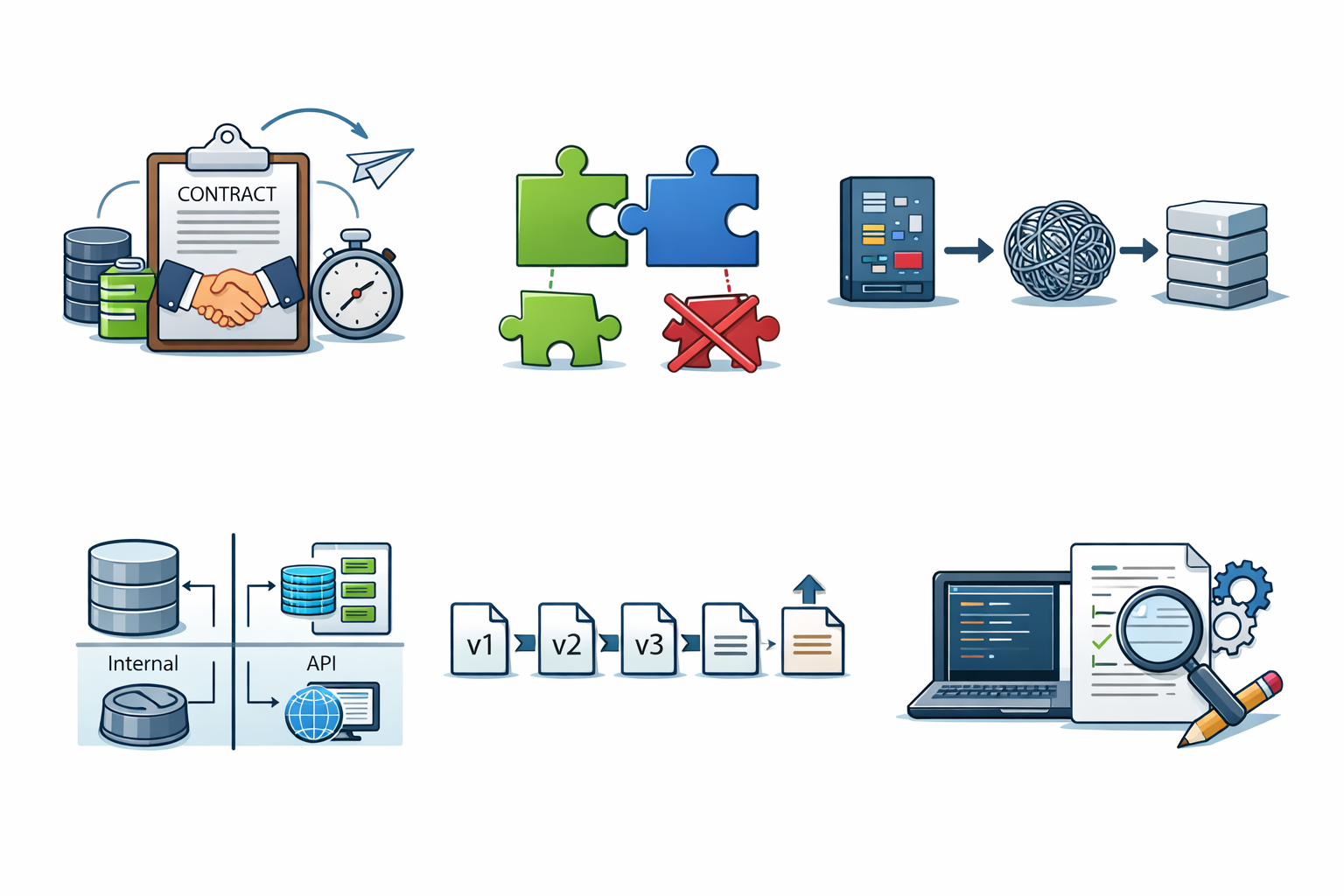
These are boring. But they work.
1. Contract-First Thinking (Even If You’re Fast)
Contract-first thinking means defining your API response structure before writing business logic. Even in fast-moving teams, locking the request and response shape early prevents accidental breaking changes later.
It forces clarity about what is guaranteed, what is optional, and how the API can safely evolve as the product grows.
Before writing controllers:
- Define response shape
- Lock field naming conventions
- Decide which fields are optional vs guaranteed
- Think about how this might evolve
We use lightweight OpenAPI specs — not for documentation, but for discipline.
Even if you don’t fully automate it, having a contract document reduces accidental breaking changes.
2. Extend, Don’t Mutate
“Extend, don’t mutate” means you add new fields instead of changing or removing existing ones. Renaming or deleting fields may feel cleaner, but it often breaks clients in subtle ways.
By extending responses and deprecating gradually, you preserve stability while still allowing the API to evolve safely.
Rule we follow:
- Never remove fields
- Never rename fields
- Only add optional fields
If something must change:
- Add new field
- Deprecate old one
- Remove only after clear timeline
This single rule dramatically reduces versioning chaos.
3. Avoid Microservices Until You Feel Real Pain
Microservices should solve a real problem, not an imagined future one. If your team isn’t struggling with deployment bottlenecks, scaling limits, or clear domain boundaries, splitting services usually adds unnecessary complexity.
For small teams, a well-structured modular monolith is often easier to maintain, test, and evolve than a distributed system introduced too early.
Real pain means:
- Independent scaling needs
- Clear domain boundaries
- Dedicated ownership per service
- Deployment bottlenecks caused by monolith size
If your API deploy takes 2 minutes, you don’t need microservices.
We’ve successfully scaled a modular monolith to tens of thousands of users without splitting services.
Modular monolith > accidental distributed system.
4. Separate Internal Models From API Models
Separating internal models from API models means your database schema is not your public contract. Instead of exposing raw tables or ORM objects, you map them to stable response objects designed for clients.
This extra layer protects you when the database changes, so internal refactoring doesn’t accidentally break external integrations.
Never expose database models directly.
Always map:
- DB model → Domain model → API response DTO
Yes, it feels like extra work.
But when schema changes come (and they will), you’ll be grateful.
5. Keep Versioning Simple
Keeping versioning simple means choosing one clear strategy and sticking to it. For most small teams, a single URL-based version (like /v1) is enough until a real breaking change forces a new version.
Complex version rules usually create more confusion than stability. Clear backward compatibility policies matter more than clever versioning schemes.
For small teams:
- Use URL versioning (/v1)
- Only create new version for breaking changes
- Keep old version stable until usage drops
Don't release a version for every feature release.
In 90% of startup APIs, proper backward compatibility means you rarely need /v2.
6. Document Changes Like Engineers, Not Marketers
Document changes in a way that helps developers migrate, not impress stakeholders. Focus on what changed, why it changed, and exactly how to adapt existing clients.
Clear examples, concise changelogs, and deprecation timelines are far more useful than polished documentation with vague descriptions.
Good API documentation isn’t fancy.
It includes:
- What changed
- Why it changed
- Migration example
- Deprecation timeline
A simple CHANGELOG.md often works better than over-engineered docs portals.
When This Approach Does NOT Work
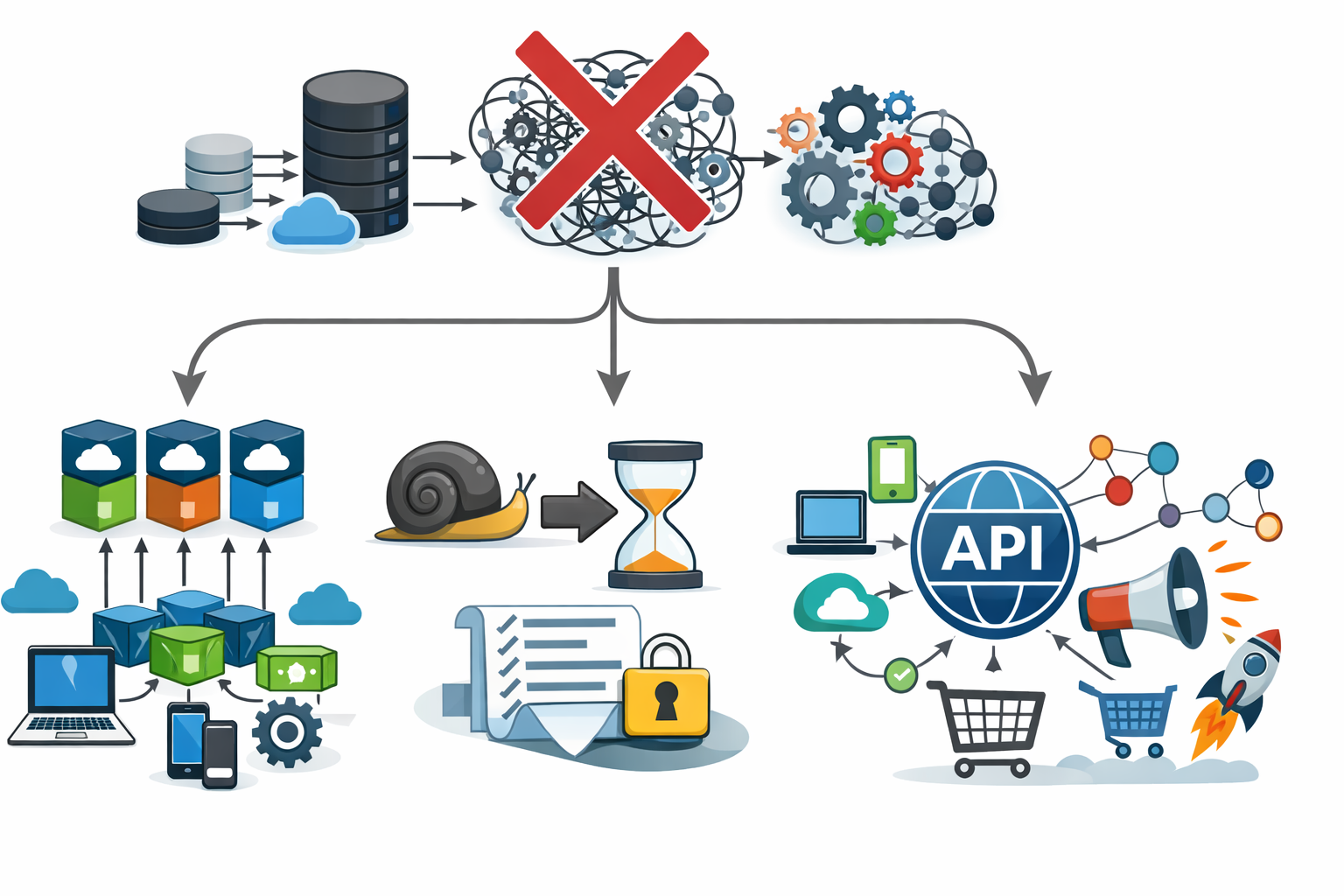
Let’s be realistic.
When Microservices Are Justified
Microservices are justified when you have clear domain boundaries, separate team ownership, and real scaling or deployment bottlenecks. If different parts of the system need to evolve independently, splitting services can reduce friction.
But the key is timing. They should solve an existing coordination or scaling problem — not be adopted as a precaution for hypothetical growth.
- You have 3+ independent product domains
- Teams are large enough to own services independently
- Deploy frequency is blocked by shared codebase
- Scaling requirements differ significantly
At that point, separation helps.
When Strict Backward Compatibility Slows You Down
Strict backward compatibility can slow teams down in very early-stage products where speed of iteration matters more than long-term stability, If you control all clients and can deploy updates instantly, maintaining old contracts may create unnecessary overhead.
In pre-product-market-fit stages, occasional breaking changes can be acceptable — as long as the impact is understood and managed carefully.
If you’re pre-product-market-fit, moving fast may matter more than stability. In very early stages, breaking changes are sometimes acceptable — as long as clients are controlled.
But once external users depend on you, that freedom disappears.
When Public APIs Change the Game
When you expose a public API, your responsibility shifts from internal convenience to external reliability. Third-party developers build real products on top of your endpoints, which means breaking changes can damage trust quickly.
Public APIs require stricter versioning, longer deprecation cycles, and clearer communication than internal APIs ever do.
If you're building a platform API (like Stripe or Twilio), the discipline required is much higher.
Public APIs demand:
- Long deprecation cycles
- Strict semantic versioning
- Clear communication
Internal startup APIs don’t need that level of process — at least not initially.
Best Practices for Small Development Teams in 2026

If you’re a 2–10 developer team, here’s what actually matters:
1. Stability Over Trendiness
Stability over trendiness means choosing architectures that your team can confidently maintain, not what’s popular in engineering blogs. A predictable, well-understood system is far more valuable than a trendy stack no one fully owns.
For small teams, boring and stable usually scales better than fashionable and complex.
Don’t chase architectural patterns from big tech. Design for your team size.
2. Simplicity Before Scalability
Simplicity before scalability means building the most straightforward solution that works today, instead of engineering for hypothetical future traffic. Over-optimizing early often adds complexity that slows development.
A clean, modular design can scale later when real demand appears — but unnecessary complexity is hard to remove once it’s in production.
Start monolithic. Modularize internally. Split only when real boundaries appear.
3. Contract Discipline
Contract discipline means treating your API schema like a long-term agreement, not a flexible implementation detail. Every change to request or response structures should be reviewed with the same seriousness as a database migration.
When teams respect the contract, accidental breaking changes drop significantly, and the API becomes predictable to evolve.
Even if informal, define response contracts clearly. Review API changes in PRs like schema migrations.
4. Design for Change
Designing for change means assuming your business logic, data structures, and client requirements will evolve. Instead of building rigid endpoints, create APIs that can grow through optional fields and additive updates.
When change is expected from the beginning, refactoring becomes manageable instead of disruptive.
Assume:
- Fields will evolve
- Business logic will change
- Clients won’t update instantly
Build with extension in mind.
5. Sustainable Documentation
Sustainable documentation means maintaining docs that your team can realistically keep updated over time. Instead of complex portals that go stale, focus on clear examples, accurate schemas, and a simple changelog.
Documentation should evolve alongside the API — not become a forgotten task after the initial release.
Keep it lightweight:
- OpenAPI spec
- Clear examples
- Simple changelog
Consistency beats perfection.
Conclusion
Most APIs don’t fail because of traffic.
They fail because of change.
If you treat your API as a temporary layer between frontend and database, it will eventually trap you.
The real API development best practice in 2026 isn’t microservices or new protocols.
It’s discipline around stability.
Build APIs that can evolve without breaking the world around them.
That’s what keeps them maintainable after 18 months — and beyond.
FAQs
No. Most small teams are better off with a modular monolith until real scaling pain appears.
Avoid breaking changes. Extend responses instead of modifying them. Version only when absolutely required.
Yes. For most SaaS products, REST remains simple, predictable, and maintainable.
Standardize authentication, centralize middleware, and avoid custom security logic per endpoint.
Only if it’s core to the product. Public APIs multiply maintenance responsibility significantly.
About the Author
Paras Dabhi
VerifiedFull-Stack Developer (Python/Django, React, Node.js) · Stellar Code System
Hi, I’m Paras Dabhi. I build scalable web applications and SaaS products with Django REST, React/Next.js, and Node.js. I focus on clean architecture, performance, and production-ready delivery with modern UI/UX.

Paras Dabhi
Stellar Code System
Building scalable CRM & SaaS products
Clean architecture · Performance · UI/UX