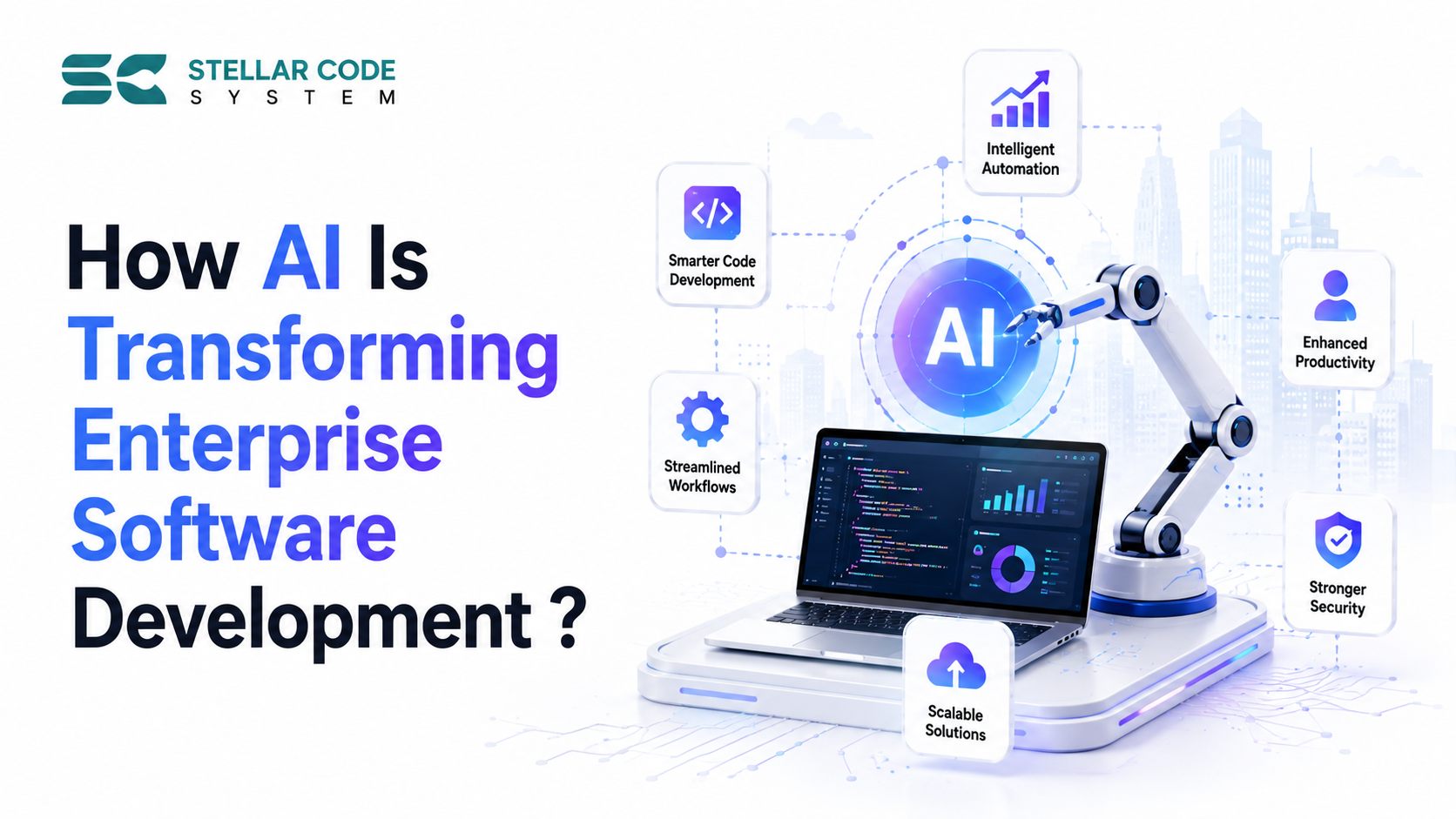
How AI Is Transforming Enterprise Software Development
Many enterprise engineering teams are adopting AI coding tools faster than they are updating their development processes.
The expectation is simple: developers become more productive, features ship faster, and engineering costs decrease.
What often happens is more complicated.
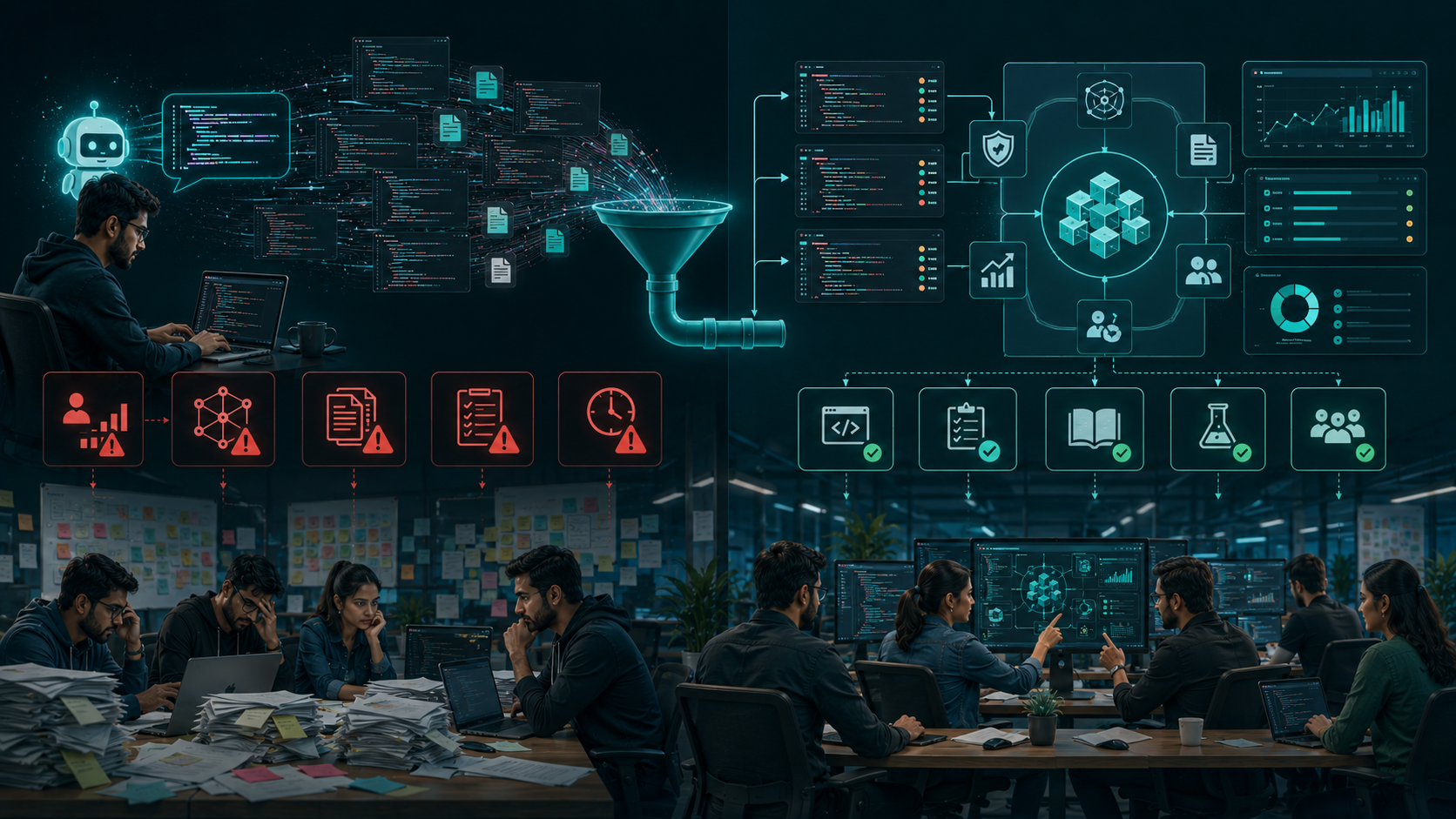
Teams suddenly generate significantly more code, but code review capacity remains the same. Documentation quality becomes inconsistent. Architectural decisions become fragmented. Technical debt starts accumulating in places that are difficult to detect during normal development cycles.
I've seen engineering teams reduce feature delivery time by half using AI-assisted development, only to discover months later that maintainability, consistency, and system understanding had quietly deteriorated.
The challenge isn't whether AI can generate code. It clearly can.
The real challenge is how enterprise software teams adapt their engineering practices when code production becomes dramatically faster than architectural oversight.
Why This Problem Happens in Real Teams
The issue typically starts with a reasonable assumption.
If developers can write code faster, the team becomes more productive.
While that is partially true, enterprise software development has never been limited solely by typing speed.
In most organizations, bottlenecks exist elsewhere:
- Architectural alignment
- System design decisions
- Code review capacity
- Testing processes
- Knowledge sharing
- Cross-team coordination
- Deployment validation
AI removes one bottleneck while leaving the others unchanged.
As a result, development velocity increases while governance processes remain static.
Enterprise Teams Often Underestimate Secondary Effects
When developers generate code more quickly, several things happen simultaneously:
- Pull requests become larger
- More changes enter the review pipeline
- Architectural inconsistencies increase
- Duplicate implementations appear across teams
- Documentation falls behind implementation
In remote engineering teams, these problems become even more visible.
Without frequent face-to-face collaboration, developers rely heavily on shared standards and architectural consistency. AI-generated implementations often vary significantly depending on prompts, developer experience, and project context.
The result is a codebase that works but becomes increasingly difficult to reason about.
AI Accelerates Existing Engineering Habits
AI rarely creates new engineering problems.
Instead, it amplifies existing ones.
Teams with strong architecture practices usually benefit significantly.
Teams with weak engineering discipline often create technical debt at a much faster rate.
The difference is not the technology.
The difference is the development process surrounding it.
Where Most Teams Make the Wrong Decision
One of the most common mistakes I see is treating AI as a replacement for engineering judgment.
That assumption causes problems quickly.
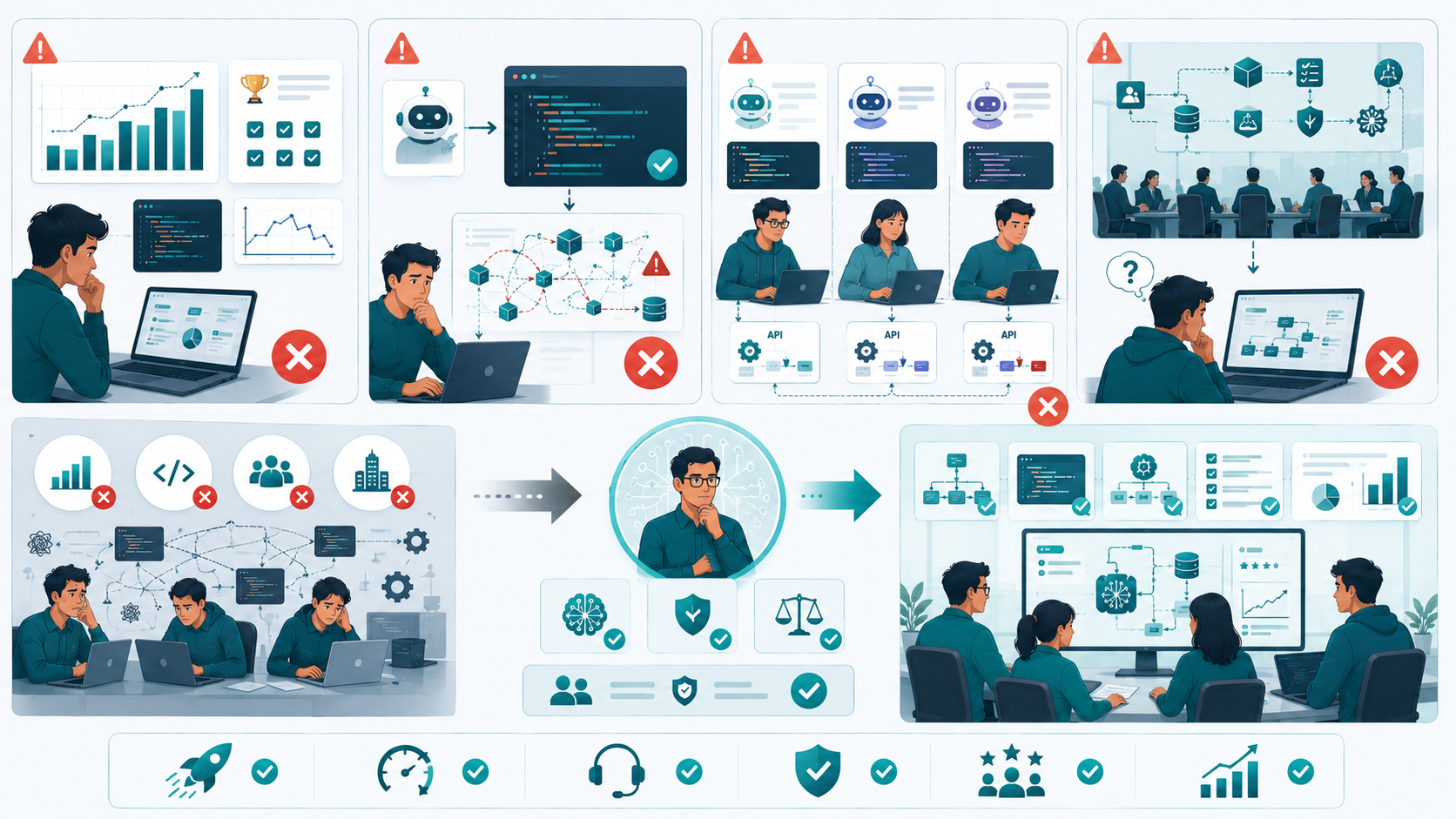
Mistake #1: Measuring Success by Code Volume
Many teams use metrics like lines of code, completed tickets, and feature output to measure AI productivity. While AI can significantly increase code generation speed, these numbers do not reflect software quality or maintainability. True engineering success comes from delivering reliable, scalable systems rather than simply producing more code.
Many organizations initially focus on metrics like:
- Lines of code produced
- Tickets completed
- Features delivered
- Development velocity
Those metrics become misleading when AI is involved.
A developer can generate thousands of lines of code in minutes.
That does not mean the architecture improved.
It does not mean the system became easier to maintain.
It does not mean operational complexity decreased.
More code is not always more value.
Mistake #2: Assuming Generated Code Is Production-Ready
AI-generated code often looks polished and functions correctly at first glance. However, it may overlook important business rules, architectural standards, security requirements, and operational constraints. Without proper review, seemingly correct code can introduce long-term maintenance and scalability problems.
AI-generated code often appears polished.
It follows syntax correctly.
It usually compiles.
It frequently solves the immediate problem.
However, enterprise software introduces concerns that AI cannot fully understand from a prompt:
- Existing architectural patterns
- Historical technical decisions
- Security requirements
- Compliance obligations
- Performance constraints
- Operational dependencies
I've seen generated code pass unit tests while violating critical architectural boundaries that took years to establish.
The code wasn't technically wrong.
It simply lacked organizational context.
Mistake #3: Allowing Every Developer to Use AI Differently
When developers use AI without shared guidelines, teams can end up with inconsistent coding patterns and implementation approaches. Over time, these differences make systems harder to maintain and understand. Standardized engineering practices are essential to keep AI-assisted development aligned across teams.
This problem becomes significant in larger engineering organizations.
Without clear guidelines, developers create entirely different implementations for similar requirements.
For example:
- Team A generates API endpoints one way.
- Team B generates them differently.
- Team C introduces another pattern entirely.
Six months later, nobody knows which pattern should be considered standard.
The problem isn't AI.
The problem is the lack of shared engineering conventions.
Mistake #4: Copying AI-Driven Development Practices From Large Tech Companies
Many organizations try to replicate AI workflows used by major technology companies without considering their own team size and resources. Large enterprises have dedicated architecture, platform, and governance teams that smaller organizations often lack. Successful AI adoption requires adapting practices to your team's actual capabilities and constraints.
Many articles discuss how major technology companies use AI internally.
Smaller enterprise teams often attempt to replicate those approaches.
The reality is different.
Large organizations typically have:
- Dedicated platform teams
- Internal governance frameworks
- Extensive review systems
- Mature architecture groups
- Significant engineering budgets
Most enterprise software teams do not.
What works for a 2,000-engineer organization may fail completely for a 20-person product team.
Practical Fixes That Actually Work
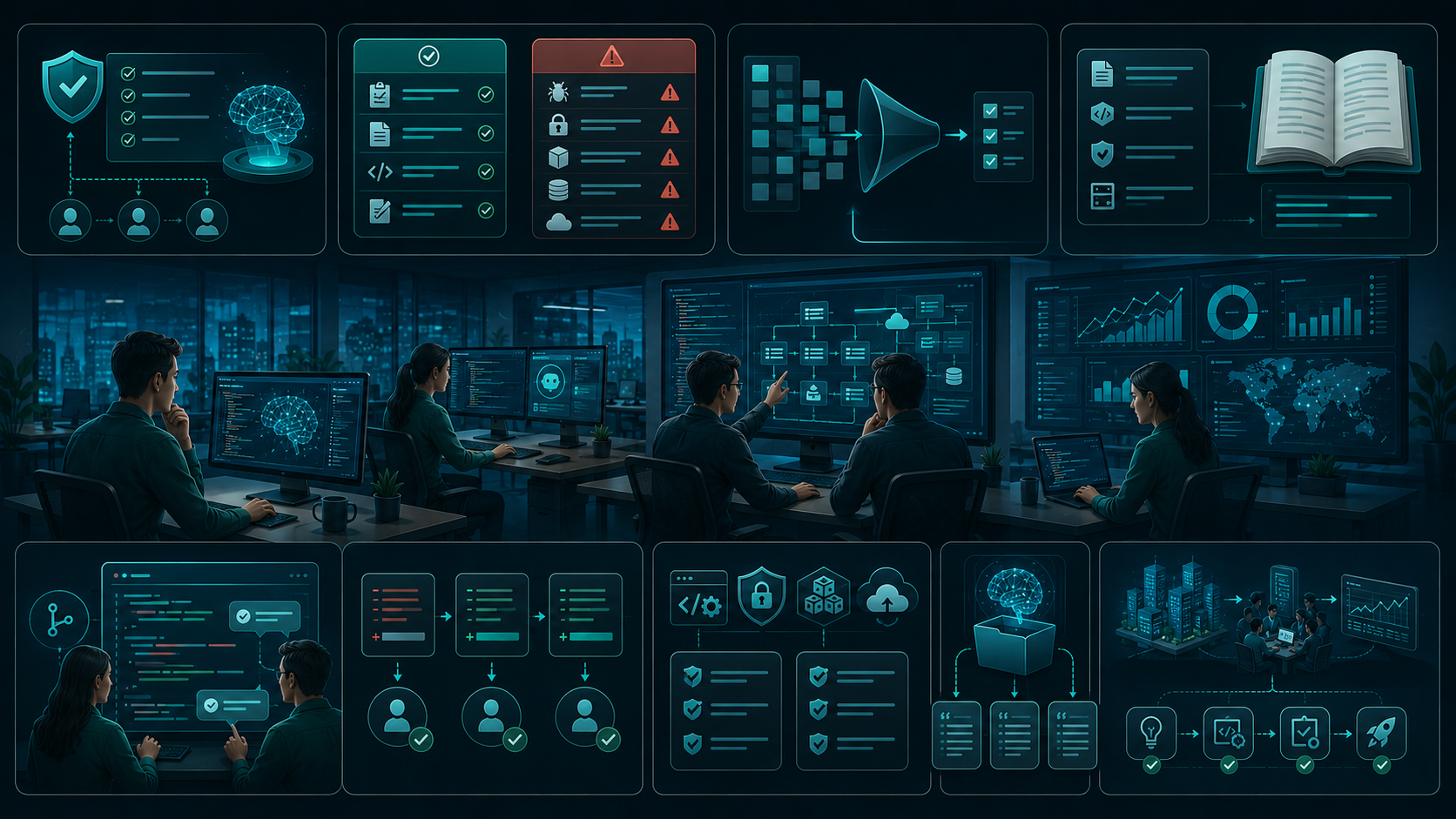
The most successful AI adoption projects I've seen focused less on tooling and more on process changes. Working with a software development company in USA for enterprise AI projects helps teams connect AI-assisted development with architecture governance, review quality, documentation, and long-term maintainability.
1. Define AI Usage Standards Early
AI can be highly effective when used for repetitive and low-risk development tasks, but not every use case should be treated the same. Establishing clear guidelines helps teams understand where AI adds value and where additional oversight is required. Consistent standards reduce risk and improve code quality across projects.
For example:
This creates consistency across engineering teams.
Good candidates
- Unit tests
- CRUD operations
- Documentation drafts
- Internal tooling
- Repetitive boilerplate
Require additional review
- Security-sensitive code
- Core business logic
- Architecture changes
- Database migrations
- Infrastructure automation
2. Review Architectural Decisions, Not Just Code
AI-generated code may solve immediate problems, but it does not automatically align with long-term architectural goals. Teams should focus reviews on system design, dependencies, maintainability, and scalability rather than only implementation details. Strong architectural oversight prevents costly technical debt later.
With AI-assisted development, architecture becomes the more important review target.
Ask questions like:
- Does this follow existing patterns?
- Does this introduce new dependencies?
- Will another team understand this six months from now?
- Does this increase operational complexity?
These discussions prevent long-term maintenance problems.
3. Reduce Pull Request Size
AI allows developers to create large amounts of code quickly, which can overwhelm reviewers and slow down delivery. Smaller pull requests are easier to understand, test, and validate. Incremental reviews improve collaboration while reducing the chances of defects reaching production.
That creates review bottlenecks.
Instead:
- Keep pull requests small
- Separate refactoring from feature work
- Review incrementally
- Merge frequently
Smaller changes improve code quality and reduce review fatigue.
4. Invest in Documentation More Aggressively
As AI accelerates development, documentation becomes even more important for maintaining clarity across teams. Recording architectural decisions, API standards, and deployment processes helps developers understand systems beyond the code itself. Well-maintained documentation improves long-term maintainability and onboarding.
Documentation becomes increasingly important.
Document:
- Architectural decisions
- Service boundaries
- API standards
- Dependency rules
- Deployment expectations
Enterprise teams that maintain strong documentation usually experience fewer AI-related maintenance issues.
5. Create Shared Prompt Libraries
When every developer uses different prompts, AI-generated outputs can become inconsistent across the codebase. Shared prompt libraries help standardize development practices, testing approaches, and documentation formats. This creates more predictable results and improves collaboration across engineering teams.
Instead of every developer creating prompts independently:
Maintain internal prompt standards for:
- API generation
- Testing patterns
- Documentation
- Error handling
- Security validation
This improves consistency across teams.
Example From a Real Enterprise Environment
One product team reduced feature implementation time significantly after introducing AI-assisted workflows.
However, after three months they noticed:
- Review queues doubling
- Duplicate utility functions appearing
- API inconsistencies increasing
- Technical debt growing
The solution wasn't a better AI tool.
The solution was:
- Smaller pull requests
- Stronger architecture reviews
- Shared coding standards
- Mandatory documentation updates
Development speed remained high while maintainability improved.
When This Approach Fails
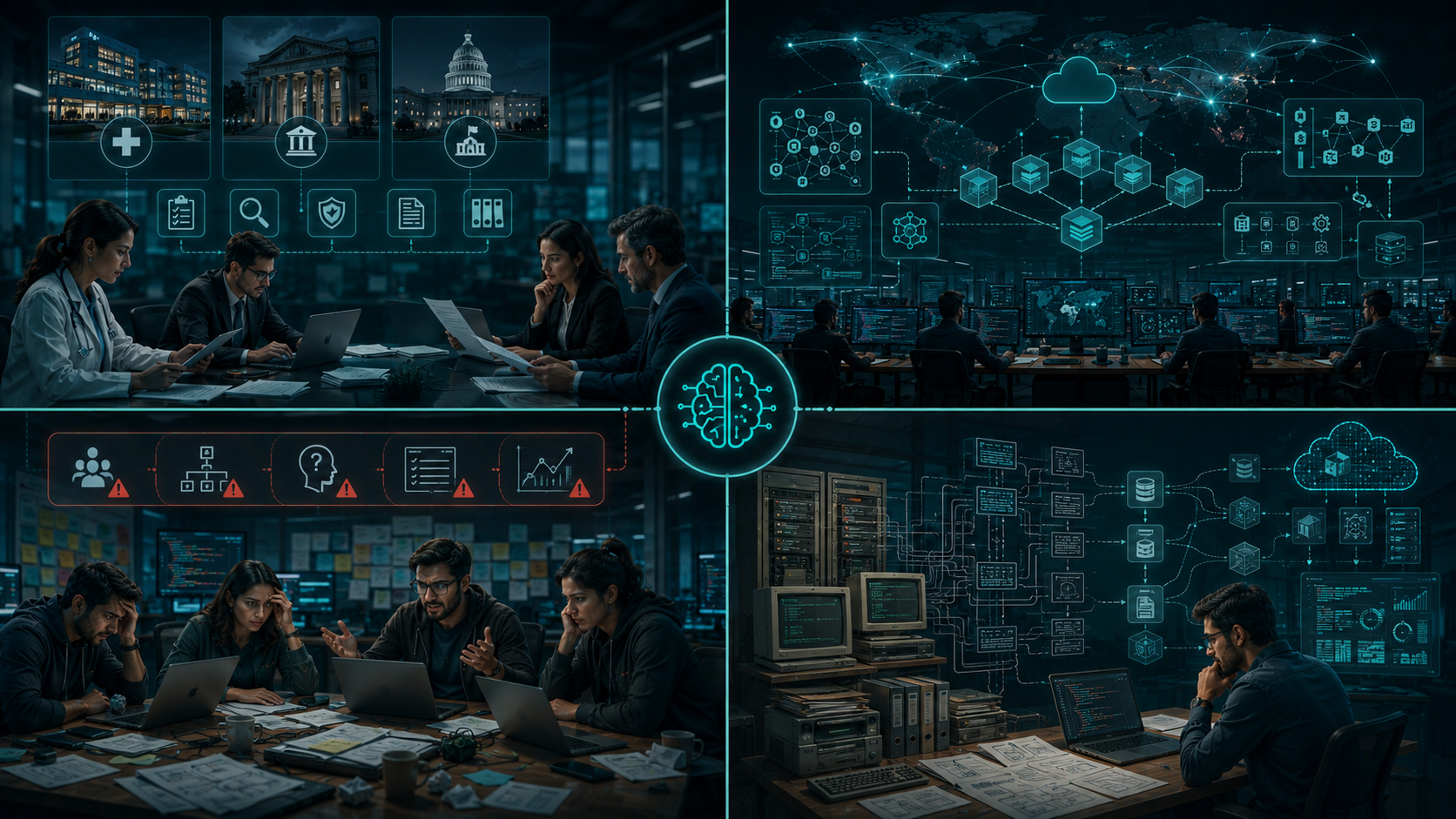
Industries such as healthcare, finance, and government operate under strict compliance and audit requirements. Even when AI accelerates development, organizations must still complete validation, documentation, and regulatory reviews. These additional processes can reduce the overall productivity gains that AI promises.
There are situations where these practices become less effective.
Highly Regulated Industries
Organizations operating under strict compliance requirements often require:
- Formal validation
- Extensive audits
- Regulatory reviews
- Traceability documentation
The review overhead can offset much of the productivity gain.
Large Distributed Enterprise Architectures
Large enterprise systems often consist of numerous services, teams, and integrations spread across different regions and departments. In these environments, AI-generated code can introduce inconsistencies and architectural risks that are difficult to manage centrally. Strong governance and experienced architectural oversight become essential.
As systems become more complex:
- Hundreds of services
- Multiple engineering departments
- Global infrastructure
- Complex integration layers
AI-generated code introduces risks that become difficult to manage centrally.
Human architectural oversight becomes increasingly important.
Teams Without Senior Engineering Leadership
AI can help developers move faster, but it cannot replace the strategic thinking of experienced technical leaders. Teams without strong engineering guidance often prioritize quick implementation over long-term maintainability. This can lead to growing technical debt and architectural challenges over time.
It cannot replace technical leadership.
Teams lacking experienced architects often struggle to distinguish between:
- Fast solutions
- Sustainable solutions
Over time, this creates maintainability issues.
Legacy Enterprise Platforms
Older enterprise applications often contain years of business logic, custom integrations, and historical dependencies. AI tools typically lack the full context needed to understand these complex systems. As a result, experienced engineers remain critical for making safe changes and avoiding unintended consequences.
Older enterprise systems frequently contain:
- Historical dependencies
- Custom integrations
- Decade-old business rules
AI models often lack enough context to safely navigate these environments.
Manual engineering expertise remains essential.
Sustainable Practices for Small Engineering Teams
For teams between 2 and 15 developers, sustainability matters more than raw development speed.
Optimize for Maintainability
Sustainable software development requires thinking beyond immediate delivery deadlines. Teams that prioritize long-term maintainability make better architectural and implementation decisions over time. Focusing on what will remain understandable and manageable in the future helps reduce technical debt and support business growth.
Ask: "Will this still make sense next year?"
Not: "Can we ship this today?"
The second question creates technical debt.
The first creates stable software.
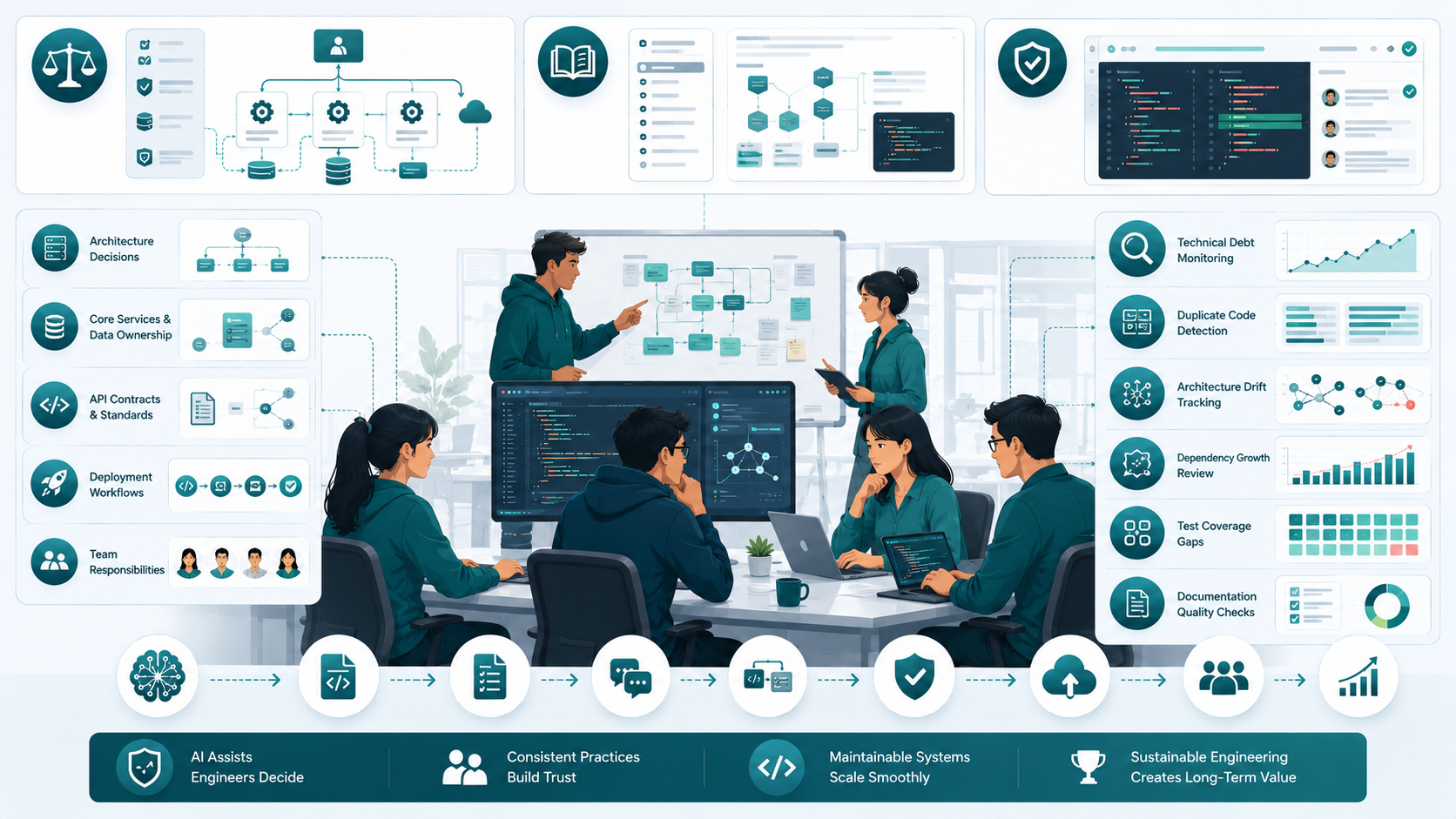
Maintain a Living Architecture Document
As systems evolve, documentation should evolve with them. Keeping architecture documents current helps teams understand system boundaries, responsibilities, and workflows without relying on tribal knowledge. This becomes especially valuable as AI-generated code increases development speed.
Document:
- Core services
- Data ownership
- API contracts
- Deployment workflows
- Team responsibilities
This reduces confusion as AI-generated contributions increase.
Protect Review Quality
AI can accelerate coding, but it should not reduce the importance of code reviews and architectural discussions. Strong review practices help identify design issues, security concerns, and maintainability risks before they reach production. Maintaining review quality is essential for healthy engineering growth.
As development speed increases:
- Do not reduce review standards
- Do not skip architectural discussions
- Do not rush deployment approvals
Review quality often becomes the limiting factor in healthy AI adoption.
Standardize Engineering Decisions
Consistency helps engineering teams scale more effectively than constantly introducing new approaches. Standardized deployment processes, testing methods, API conventions, and documentation practices make systems easier to maintain and support. Predictable workflows also improve collaboration across teams.
For small SaaS products and enterprise platforms:
- One deployment approach
- One testing strategy
- One API style
- One documentation structure
Predictability reduces long-term maintenance costs.
Monitor Technical Debt Explicitly
Technical debt often grows quietly while teams focus on feature delivery and release schedules. Regular reviews of code quality, architecture, dependencies, and documentation help identify issues before they become costly problems. Tracking technical debt intentionally keeps development sustainable as AI adoption increases.
Few track technical debt with the same discipline.
Create regular reviews for:
- Duplicate code
- Architectural drift
- Dependency growth
- Test coverage gaps
- Documentation quality
AI can accelerate debt accumulation if nobody measures it.
Conclusion
AI is transforming enterprise software development, but the biggest changes are happening outside the code itself.
The most successful engineering teams are not simply generating more code. They are adapting their review processes, architectural governance, documentation standards, and collaboration workflows to match a new development reality.
The biggest mistake organizations make is assuming AI productivity automatically translates into better software.
In practice, AI increases development speed. Sustainable engineering still depends on architecture, process discipline, and experienced technical judgment.
Teams that recognize this distinction tend to gain the most value while avoiding the technical debt traps that often follow rapid AI adoption.
FAQ
No. AI is primarily increasing developer productivity. Architectural decisions, system design, security reviews, and business-context understanding still require experienced engineers.
It can. Technical debt usually appears when generated code bypasses architectural standards, documentation requirements, or proper review processes.
Yes, but with clear governance. Production code should follow the same review, testing, and architectural validation standards as manually written code.
Remote teams benefit from standardized coding practices, shared prompt libraries, strong documentation, and architecture-focused code reviews.
The biggest risk is increasing code production faster than an organization's ability to review, maintain, and govern that code effectively.
Reference
Written by

Paras Dabhi
VerifiedFull-Stack Developer (Python/Django, React, Node.js)
I build scalable web apps and SaaS products with Django REST, React/Next.js, and Node.js — clean architecture, performance, and production-ready delivery.
LinkedIn