How to Design Scalable Software Architecture

I’ve seen this pattern too many times. A small team ships fast for 6 months. Everything feels fine. Features go out weekly.
Then one day, small changes start breaking unrelated parts. Deployments feel risky. Bugs multiply. Every fix takes longer.
At that point people say, “We need better architecture.”
But by then, it’s already messy.
This usually isn’t a skill problem. It’s a design approach problem.
Why this problem actually happens

In small teams, architecture decisions aren’t deliberate.
They just… happen.
Not because developers don’t care — but because:
- There’s pressure to ship this week
- Founders want features, not refactors
- There’s no dedicated architect
- Everyone is multitasking
So the system grows like this:
“Let’s just add it here for now.”
Then six months later, “here” is everywhere.
What I’ve noticed:
- Logic leaks across modules
- Database becomes the integration layer
- Every service knows too much about every other service
- One small change touches 10 files
It’s not bad code.
It’s tight coupling created by rushed decisions.
Most early-stage teams accidentally build a ball of mud.
Where most developers or teams get this wrong

I see the same mistakes repeatedly.
1. They over-engineer too early
I’ve seen small teams add microservices, complex CI pipelines, and heavy infrastructure before they even have real traffic.
It feels “future-proof,” but it actually slows development and creates unnecessary moving parts.
Instead of building features, the team ends up maintaining complexity they didn’t need in the first place.
Someone reads about microservices and thinks:
“We should split everything from day one.”
Now you have:
- 7 services
- Docker everywhere
- Network failures
- Deployment complexity
…for a team of 3 devs.
I’ve seen startups spend more time fixing service communication than building features.
2. Or they under-design completely
Sometimes teams go the opposite way and skip structure entirely, throwing everything into one growing codebase with no clear boundaries.
It works fast at the start, but over time features get tangled, bugs spread across modules, and even small changes feel risky.
What looked “simple” early quietly turns into a system that’s hard to understand and painful to maintain.
The opposite extreme:
- One giant codebase
- One database
- Everything imports everything
It feels fast initially.
Then:
- tests slow down
- refactors are scary
- onboarding takes weeks
3. They design around tools, not boundaries
I’ve seen teams spend hours debating frameworks, APIs, or which stack to use, thinking the tool will magically fix their structure problems.
But swapping tools doesn’t solve tight coupling or unclear responsibilities.
If boundaries between features aren’t defined first, even the best tech stack turns into a mess over time.
Questions like:
- “Should we use GraphQL?”
- “Should we use serverless?”
- “Should we use X framework?”
These don’t fix architecture.
The real question is:
“Where should responsibilities be separated?”
Tools don’t solve poor boundaries.
4. They chase “perfect structure”
I’ve seen teams waste days reorganizing folders, renaming layers, and debating the “cleanest” project structure instead of solving real problems.
It feels productive, but it rarely improves maintainability or scalability.
Clear ownership and simple boundaries matter far more than a perfectly arranged directory tree.
I’ve seen teams waste weeks restructuring folders.
Folders don’t scale systems.
Clear ownership and isolation do.
Practical solutions that work in real projects
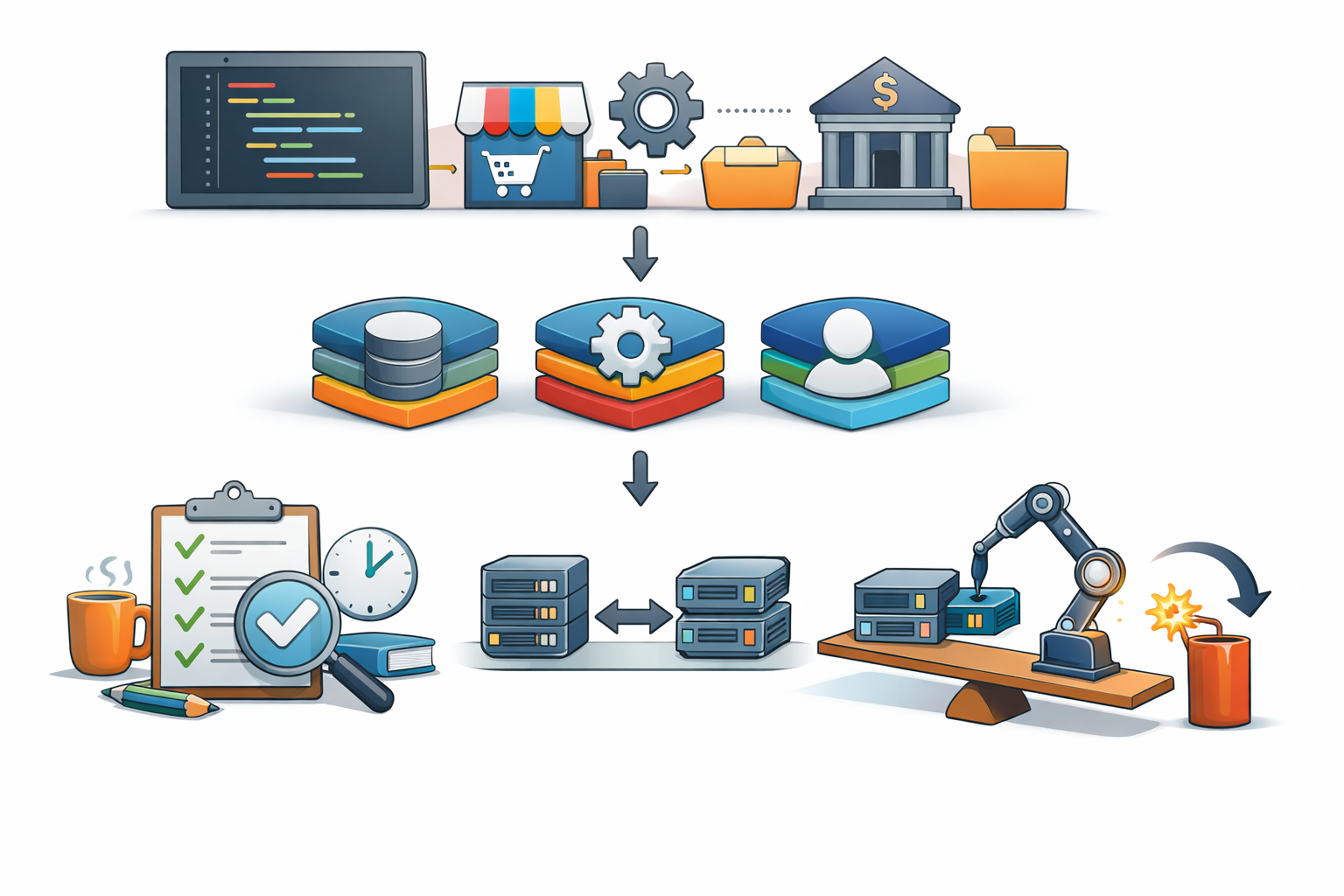
This is what I actually do now when starting or cleaning up a project.
Nothing fancy. Just boring, predictable structure.
Step 1 — Start with one codebase (yes, one)
For small teams, a single codebase keeps things simple and predictable.
One repo, one deploy process, and one place to debug means fewer moving parts and less operational overhead.
You can move faster, onboard developers easily, and avoid the complexity that multiple services introduce too early.
For teams under 10 devs:
- single repo
- single deployable app
- single database
This keeps:
- debugging simple
- deployments easy
- onboarding fast
Microservices add operational overhead you probably don’t need yet.
You can scale surprisingly far with one app.
Step 2 — Separate by business boundaries, not tech layers
Instead of organizing code by controllers, services, or models, group it by features like billing, auth, or orders.
This keeps related logic in one place and reduces cross-dependencies between unrelated parts of the system.
When boundaries match the business, changes stay local and refactoring becomes much safer.
Most teams structure like:
- controllers
- services
- utils
- models
This creates cross-dependencies fast.
Instead, I group by feature/domain:
- billing/
- auth/
- orders/
- notifications/
Each folder contains everything it needs.
Inside:
- API
- logic
- queries
- tests
This way:
- billing doesn’t import auth internals
- changes stay local
- refactors are safer
This single decision has saved me more pain than any framework choice.
Step 3 — Enforce “boring rules”
Simple rules like “no cross-module imports” or “each feature owns its own data” may feel restrictive, but they prevent long-term chaos.
These constraints force developers to keep boundaries clean and avoid hidden dependencies.
In my experience, boring, consistent rules protect the codebase far better than clever architecture patterns.
Some rules I always add:
- No cross-domain imports
- Shared code only in a small “core” folder
- No direct DB access outside the domain
- Each module owns its tables
These constraints feel annoying early.
But they prevent long-term chaos.
Good architecture is mostly restrictions, not freedom.
Step 4 — Design for replaceability
Assume that anything you add today might need to be swapped out tomorrow — payment providers, databases, or third-party services.
Keep those dependencies behind small adapters or interfaces so the rest of the system doesn’t depend on their details.
This way, changes stay isolated and you avoid painful rewrites when requirements shift.
Before adding something, I ask:
“If we had to replace this later, how painful would it be?”
Examples:
- wrap third-party APIs behind adapters
- avoid leaking vendor-specific logic
- keep business logic framework-agnostic
I once swapped a payment provider in 2 days because it was isolated.
Without that boundary, it would’ve taken weeks.
Step 5 — Keep scaling decisions reversible
Early decisions shouldn’t lock you into a path that’s hard to undo later.
Avoid tight coupling, shared databases across modules, or setups that require a full rewrite to change direction.
If choices are reversible, you can adapt as the product grows without breaking half the system every time you scale.
Avoid choices that lock you in:
Bad:
- hard-coded assumptions
- tight service coupling
- shared databases across modules
Better:
- clear interfaces
- message passing
- isolated data ownership
Reversibility is underrated.
When this approach does NOT work

This isn’t universal advice.
It breaks in some cases.
It doesn’t fit when:
- You have 20+ developers already
- Independent teams deploy separately
- Different parts need very different scaling
- You handle extreme traffic or compliance constraints
In those cases, service separation may make sense earlier.
Also, if your domain is extremely complex (fintech, large marketplaces), you might need more formal design upfront.
For most small teams though, complexity usually comes from architecture, not business logic.
Best practices for small development teams

These are habits that kept my projects stable long-term.
Keep these simple rules:
- Ship weekly, not monthly
- Freeze scope during sprints
- Delete code aggressively
- Prefer simple queries over clever abstractions
- Track time per feature (if it’s slowing down, architecture is leaking)
- Do small refactors continuously, not big rewrites
Talk about boundaries early
Every time we add a feature, I ask:
“Where does this belong? Who owns it?”
Five minutes of thinking here can save months later.
Architecture isn’t diagrams.
It's a small daily decision.
Conclusion
Most small teams don’t fail because they lack fancy architecture.
They fail because everything slowly becomes connected to everything else.
From experience, the most scalable systems I’ve built were:
single app
clear domain boundaries
strict separation rules
boring tech
Nothing impressive on paper.
But it's easy to change.
And that’s what scalability really is — not handling millions of users, but being able to change safely without breaking everything.
FAQs
Usually no. For under 10 devs, the operational cost is higher than the benefit.
If small changes affect many unrelated files, your boundaries are leaking.
Not inherently. Many large systems scale fine with a well-structured monolith.
From day one — but keep it simple and reversible.
Rarely. Gradual refactoring inside clear boundaries is almost always safer.
About the Author
Paras Dabhi
VerifiedFull-Stack Developer (Python/Django, React, Node.js) · Stellar Code System
Hi, I’m Paras Dabhi. I build scalable web applications and SaaS products with Django REST, React/Next.js, and Node.js. I focus on clean architecture, performance, and production-ready delivery with modern UI/UX.

Paras Dabhi
Stellar Code System
Building scalable CRM & SaaS products
Clean architecture · Performance · UI/UX